Query fan out, and why one query is not one query
Google publishes the definition. Seer measured the breadth at 10.7 sub-queries per prompt, and 95 percent of those sub-queries have zero search volume. That is not trivia. That means your keyword report is describing a set of queries the engine never ran.

- Google's own documentation defines query fan-out as a set of concurrent, related queries the model generates to fetch additional results for your question.
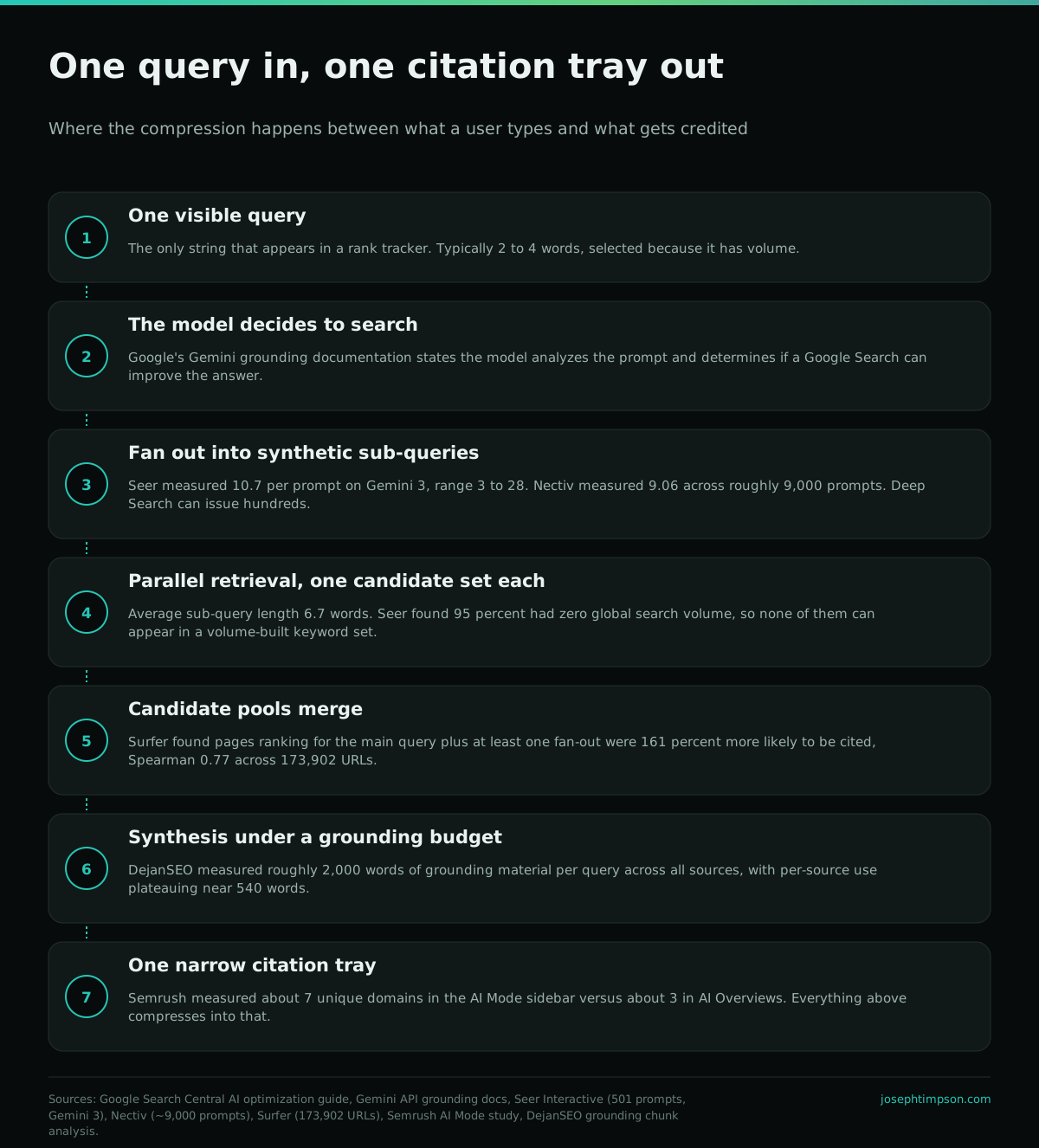
- Seer Interactive measured 10.7 fan-out queries per prompt on Gemini 3 across 501 prompts, with a range of 3 to 28. Nectiv measured 9.06 across roughly 9,000 prompts.
- 95 percent of those fan-out queries had zero global search volume, which means they cannot exist in a keyword tracker built on volume.
- Surfer found pages ranking for the main query plus at least one fan-out query were 161 percent more likely to be cited in an AI Overview.
- Two first-party surfaces expose real retrieval queries: grounding queries in Bing Webmaster Tools, and the search-call field returned by the Gemini API.
The definition, from the people who built it
Fan-out is treated across most of the industry as an unknowable black box. It is not. Google published the definition, in its own documentation, in plain English.
Query fan-out is the engine generating a set of related queries from your single question, running them at the same time, and synthesizing one answer from everything they return. Google defines it as "a set of concurrent, related queries generated by the model to request more information and fetch additional relevant search results to address the user's query". The consequence practitioners keep skipping: the query in your rank tracker is almost never the query that performed the retrieval.
Two primary sources fill in the shape. Elizabeth Reid, VP and Head of Search, described the mechanism in Google's own I/O announcement as breaking a question into subtopics and issuing many queries at once. Robby Stein, VP of Product for Search, used the phrase first in the original AI Mode launch post, and later gave Search Engine Journal the least formal and most useful version of it: for a question like things to do in Nashville with a group, the system thinks of a bunch of related questions and "start Googling basically".
The patent record predates both. Google's Search with stateful chat application, published 29 August 2024 and assigned to Google LLC, describes a system that works by "generating one or more synthetic queries using the LLM output" and then selecting documents responsive to both the user's query and the generated ones.
Here is what actually matters about that documentation page, and almost nobody says it out loud. Google names exactly two mechanisms behind its generative features: retrieval augmented generation, and query fan-out. On the same page it says structured data is not required and you do not need to create AI text files. Fan-out is the machinery. The file formats and markup packages the GEO market sells around it are, by the vendor's own account, not the machinery. If you have been sold an llms.txt implementation or a schema package as an AI citation lever, you bought decoration attached to a mechanism that does not read it.
AI Mode uses our query fan-out technique, breaking down your question into subtopics and issuing a multitude of queries simultaneously on your behalf.
How wide the fan actually gets
Google has never published a per-query fan-out count. The only figures from Google itself are Reid's word "multitude" and her statement that Deep Search "can issue hundreds of searches" behind a single prompt. Everything more precise comes from third parties reading the Gemini API, and two of those studies are good.
Seer Interactive forced grounding on 501 tracked prompts and measured Gemini 3's behaviour directly. Nick Haigler's Gemini 3 fan-out research found an average of 10.7 fan-out queries per prompt, with a range of 3 to 28, and an average query length of 6.7 words. Independently, Chris Long at Nectiv ran roughly 9,000 prompts through the Gemini API and logged over 70,000 fan-out rows, landing at 9.06 fan-outs per prompt with 59 percent of prompts producing between 5 and 11.
Two independent methods landing at 9.06 and 10.7 is about as much agreement as this field ever produces. Take 9 to 11 as the working estimate for grounded Gemini 3 prompts and stop there.
The more useful finding is that the multiplier is not constant. Nectiv's industry split puts software at 11.7 fan-outs per prompt and local queries at 3.79. That is a three-fold difference in how badly the reporting problem bites. A local services client's keyword report is much closer to describing reality than a B2B software client's, and if you run both, you should not be applying the same confidence to both dashboards.
Seer also measured the drift between model versions, and it is steep enough that every number in this post has a shelf life measured in model releases.
Compared to Gemini 2.5, query fan-outs are up 78%, jumping from an average of 6.01 in Gemini 2.5 to 10.7 in Gemini 3.
It uses a 'query fan-out' technique, issuing multiple related searches concurrently across subtopics and multiple data sources and then brings those results together to provide an easy-to-understand response.
The number that breaks the keyword report
One finding in the Seer study does more damage to standard reporting than everything else combined. Haigler's data shows 95 percent of the queries Gemini generated for fan-out had zero global search volume.
Sit with the mechanics of that. Keyword sets are assembled by volume. Volume is the selection filter in every tool anyone uses. So the sub-queries doing the actual retrieval are, as a class, systematically excluded from the set of queries you can even find, let alone track. This is not a coverage gap you close by buying a bigger keyword database. It is a category error: the thing you are sampling and the thing that determines the outcome are drawn from different populations.
The volatility layer makes it worse. Seer reported only 1 percent data overlap across its full fan-out dataset. Rand Fishkin's SparkToro work with Gumshoe.ai found the same instability at the answer level across 2,961 prompt runs.
There's a <1 in 100 chance that ChatGPT or Google's AI, if asked 100X, will give you the same list of brands in any two responses.
Stack the two findings and you get the real shape of the problem. The retrieval layer is unstable, and the reporting layer is measuring a different layer entirely. That is why a thin prompt set produces confident nonsense, and why prompt panels need weighting and repeat sampling rather than a tidy list of twenty prompts someone picked in a kickoff call.
| What your report tracks | What the engine retrieves against | |
|---|---|---|
| Count per topic | One tracked string | 9 to 11 on average, up to 28 measured |
| Length | Typically 2 to 4 words | 6.7 words average, most between 5 and 8 |
| Selection filter | Chosen because it has volume | 95% have zero global volume |
| Stability week to week | Identical string every run | 1% overlap across the full Seer dataset |
| Visible to you | Yes, in the tracker | Only via Bing grounding queries or the Gemini API |
Your reported set and the retrieval set are different sets
If fan-out only widened retrieval, it would be an interesting fact with no commercial consequence. It does something sharper: it changes which pages win, and it does so at a level your report cannot see.
Surfer's study is the cleanest evidence. Joshua Hardwick took 10,000 keywords, extracted 33,000 fan-out queries via Gemini, and analysed 173,902 URLs. Pages ranking for the main query and at least one fan-out query were 161 percent more likely to be cited in an AI Overview than pages ranking for the main query alone, at a Spearman correlation of 0.77. Read the breakdown of citations that do rank organically: 51.2 percent rank for the main query plus a fan-out, 29.2 percent rank only for fan-out queries, and just 19.6 percent rank only for the main query.
That 29.2 percent slice is the one to internalise. Nearly a third of ranking AI Overview citations come from pages that do not rank for the query anyone typed. Those pages are invisible wins in a keyword report and always will be.
The same pattern shows up on the other side of the fence. Ahrefs analysed 1.4 million ChatGPT prompts and found cited URL titles matched ChatGPT's own internally generated fan-out queries at cosine 0.656, better than they matched the user's original prompt at 0.602, while retrieved-but-not-cited URLs sat at 0.484. Two different engines, two different research teams, same conclusion: citation is won at the sub-query level.
The compression at the end is the part people underrate. Semrush found AI Mode shows a sidebar on 92 percent of queries with about seven unique domains, against roughly three in AI Overviews. DejanSEO measured the ceiling upstream of that, finding a grounding budget of roughly 2,000 words per query across all sources combined. Nine or ten retrievals feed a single budget that fits a few thousand words and credits a handful of domains. The fan is wide, the tray is narrow, and nothing in your report shows the gap between them.
This is also the mechanical explanation for a number that confused the industry all year. Ahrefs found that only 38 percent of AI Overview citations rank in the top 10 for the originating query, down from roughly 76 percent in its own July 2025 measurement. That is not Google abandoning rankings. That is Google increasingly citing pages that rank for the fan-out rather than the head query, and it makes the "rank first and you win AI" claim a statement about the wrong SERP.
Your visibility is no longer a single position you can track.
Two places you can actually see fan-out queries
Most fan-out content ends at "so cover more subtopics", which is advice, not instrumentation. There are two surfaces where you can read real retrieval queries rather than guess at them, and one category that is guessing dressed as measurement. Microsoft ships them as grounding queries inside Bing Webmaster Tools, and Google's Gemini grounding documentation states that the search-call object returned with a grounded response contains the queries the model executed.
Bing Webmaster Tools
Microsoft's AI Performance report, in public preview since February 2026, publishes grounding queries, defined by Microsoft as the key phrases the AI used when retrieving content that was referenced in AI-generated answers. Those are fan-out queries, from the engine, for your site, for free.
The Gemini API
Google's grounding documentation states that the search-call object returned with a grounded response contains the search queries the model executed. Run your client's real questions through a grounded Gemini call and read what it actually searched.
Fan-out simulators
A generated guess at what an engine might ask. Useful for content planning, worthless as measurement. Never put simulator output in a client report as though it were observed retrieval.
The asymmetry here is worth naming. Microsoft shipped the retrieval queries as a named, free report while the AI visibility tool category was charging monthly to infer the same thing badly. On Google's side, the closest first-party instrument is the Gemini API, which is a developer surface, not a reporting one. That is the actual state of play, and it should change how you evaluate the AI visibility tracking tool you are paying for.
What to change in the report
Four changes follow directly from the evidence, and only four. Everything else in this space is speculation.
Segment the fan-out. Pull the real grounding queries from Bing Webmaster Tools and the real search calls from the Gemini API, then track coverage against them as a separate segment. Do not merge them into the keyword report, because merging a zero-volume retrieval query into a volume-ranked report destroys the meaning of both.
Measure topic coverage, not position. Surfer's 0.77 correlation is between fan-out ranking breadth and citation, and Hardwick's own recommendation is to build topical coverage rather than chase individual fan-out strings. Chasing 10.7 volatile strings per topic is a losing game with a 1 percent overlap rate. Covering the facet space is not, which is the same conclusion Aleyda Solis reaches when she argues fan-out moves search from a query-focused process to a context-focused one.
Track your own brand as a retrieval query. Seer found 26.4 percent of fan-out queries contained a brand name. When the engine fans out into "[your brand] pricing" or "[competitor] alternatives", the retrieval is running against your entity, not your keyword, which is why entity clarity and third-party brand mentions do work that on-page optimisation cannot.
Say this in the report. Not as a hedge, as a definition of scope. A client who understands that the visible query and the retrieved query are different sets will read a flat chart correctly. One who does not will read it as failure. This is a reporting design problem before it is a measurement problem, and it belongs next to your citation source analysis rather than buried in an appendix.
What fan-out does not excuse
The honest section, because this mechanism is about to become the most abused excuse in the category.
Fan-out does not mean a flat report is secretly good. "There is hidden movement underneath" is an untestable claim unless you produce the grounding queries and show the coverage change. If you cannot show it, the correct sentence is that you cannot see it, not that it is happening.
Fan-out does not retire classic ranking. seoClarity's analysis of 362,000 US desktop keywords found 90 percent of AI Overviews contained at least one URL from the top 10, and position one appeared 43 percent of the time. Ahrefs' 38 percent figure and seoClarity's 90 percent figure are measuring different units, per citation versus per answer, and both are true. Ranking is table stakes that buys you a seat at more of the fan-outs. It is not the win condition.
Fan-out does not make retrieval optional. If the crawler cannot reach the page, no amount of subtopic coverage matters, which is why crawler access sits ahead of everything else in this stack and why how your content chunks determines what any fan-out can actually pull. And it does not create attribution: there is still no deterministic path from a fan-out citation to a booked job. If you want the full sequence rather than the mechanism, the method I run puts access first and measurement second for exactly this reason, and a worked audit shows what the output looks like. More of the engine mechanics writing lives here.
The scoreboard changed. The report mostly has not. That gap is where most GEO retainers are quietly failing, and closing it starts with admitting that the query you are tracking and the query being answered are two different strings.
Frequently asked questions
What is query fan-out in AI Mode?
Google defines it as a set of concurrent, related queries generated by the model to request more information and fetch additional relevant search results for the user's query. One typed question becomes several parallel retrievals whose results are merged into a single synthesized answer with one citation set.
How many fan-out queries does Google generate per prompt?
Google has never published a number. Seer Interactive measured 10.7 per prompt on Gemini 3 across 501 grounded prompts, ranging from 3 to 28. Nectiv measured 9.06 across roughly 9,000 prompts. Deep Search is different: Google says it can issue hundreds.
Can I see the actual fan-out queries for my site?
Partly. Bing Webmaster Tools publishes grounding queries, which Microsoft defines as the phrases the AI used when retrieving your cited content. The Gemini API returns the search queries the model executed with a grounded response. Neither gives you live Google AI Mode retrieval.
Why do fan-out queries have no search volume?
They are generated by a model, not typed by people, and they average 6.7 words. Seer found 95 percent had zero global search volume. Keyword tools select by volume, so the queries doing the retrieval are structurally excluded from the sets most agencies track.
Does fan-out mean keyword tracking is useless?
No. It means keyword tracking measures a narrower thing than people claim. Ranking still buys entry to more fan-outs: seoClarity found 90 percent of AI Overviews contain a top-10 URL. Treat rank as an input, not as a proxy for AI visibility.
How do I optimize for query fan-out?
Cover the facet space rather than the string. Surfer found pages ranking for the main query plus at least one fan-out were 161 percent more likely to be cited. Chasing individual generated strings fails because they barely repeat between runs.
Do fan-out simulator tools show real queries?
No. They generate a plausible guess at what an engine might ask. That is useful for planning content coverage and useless as evidence. Do not present simulator output in a client report as observed retrieval, because it was never observed.
Does ChatGPT use query fan-out too?
Yes. Ahrefs analyzed 1.4 million ChatGPT prompts and found cited page titles matched ChatGPT's internally generated fan-out queries at cosine 0.656, better than the user's original prompt at 0.602. The breadth is generally narrower than Gemini's, but the mechanism is the same.
Sources
- Google Search Central. Optimizing your website for generative AI features on Google Search (2026-07)
- Google. AI Mode in Google Search: our most powerful AI search (2025-05)
- Google. Expanding AI Overviews and introducing AI Mode (2025-03)
- Google LLC via Google Patents. Search with stateful chat, patent application US20240289407A1 (2024-08)
- Google. Grounding with Google Search, Gemini API documentation (2026-07)
- Search Engine Journal. Query Fan-Out Technique in AI Mode: New Details From Google (2025-07)
- Seer Interactive (Nick Haigler). Initial Research: Gemini 3 Query Fan-Outs (2025-11)
- Nectiv (Chris Long). New Research: What We Learned From Analyzing 60K+ Google Fan-Out Queries (2025-12)
- Surfer (Joshua Hardwick). How Query Fan-Out Impacts AI Overview Citations (2025-12)
- Ahrefs (Louise Linehan). Why ChatGPT Cites Pages: an analysis of 1.4 million prompts (2026-04)
- Ahrefs. Only 38% of AI Overview citations rank in the top 10 (2026-03)
- Microsoft Bing Webmaster Blog. Introducing AI Performance in Bing Webmaster Tools (Public Preview) (2026-02)
- iPullRank (Lazarina Stoy). How AI Search Platforms Expand Queries with Fan-Out and Why It Skews Intent (2025-12)
- SparkToro (Rand Fishkin) with Gumshoe.ai. AIs are highly inconsistent when recommending brands or products (2026-01)
- seoClarity. AI Overviews and organic rankings overlap study (2025-10)
- DejanSEO (Dan Petrovic). How big are Google's grounding chunks? (2025-12)
- Semrush. Google AI Mode versus AI Overviews versus ChatGPT citation comparison study (2025-07)
- Aleyda Solis. Google Query Fan-Out: What is it and what does it mean for SEO (2025)
Joseph Timpson has worked in search since 2010 and runs Timpson Marketing out of St. George, Utah. He built The Cited Method, a five stage framework for earning and proving real citations in AI answers, and publishes what does not work alongside what does.
Want me to run this on your site and show you the before and after?
One call, no pitch deck. We look at what is actually blocking you and tell you the truth about whether we can help.
Book a free consultation →