A Full AI Visibility Audit, Start to Finish, in Public
The condition for this post was a client who would let me publish the findings that made them look bad. I could not get one. So the site I tore down is my own.

- Every AI visibility audit sample on the public web is either redacted or synthetic. The most widely used agency template states on its own face that all its figures are worked examples.
- The mechanical half of an audit takes about ten minutes: fetch your homepage as four different bot user agents and compare the byte counts, not the status codes.
- I did not publish a citation rate for my own site, because SparkToro measured under a 1 in 100 chance that two runs of the same prompt return the same brand list.
- Three interventions the category sells are backed by published null results: JSON-LD schema, llms.txt, and serving Markdown to crawlers. I skipped all three and named the studies.
- The largest finding on my own site was off-site, and no line item in a website audit touches it.
The site I audited had ten URLs in its sitemap
The condition on this post was a named client giving written permission to publish the findings that embarrassed them. I could not get it. Nobody in this category gets it, which is why every audit sample you can download is either redacted or invented.
Check that claim before you accept it. The widely circulated agency asset at SEO Report Kit carries this disclaimer on the template itself: "Original, synthetic sample data only. Every figure in this asset is a worked example." The My Web Audit walkthrough that ranks for this exact query names no company and reports no outcome. The LLM Pulse ten step guide is a checklist with no subject attached to it.
So the brand is me. josephtimpson.com, audited 29 July 2026, published whole. Ten URLs in the sitemap on the day I ran it, which is the least flattering sentence in this post and also the first honest number anyone has put in front of this keyword.
Every mechanical check below is reproducible. You can re-run all of stage one against my domain in about ten minutes and contradict me in public if I got it wrong.
An AI visibility audit is worth paying for only when it produces evidence you could not produce yourself in an afternoon. That is three things: a crawler access test executed with real bot user agents rather than a robots.txt read, a prompt set large enough to survive answer volatility, and a written list of the interventions that will not work with the studies attached. Everything else in a standard audit deck is restated analytics.
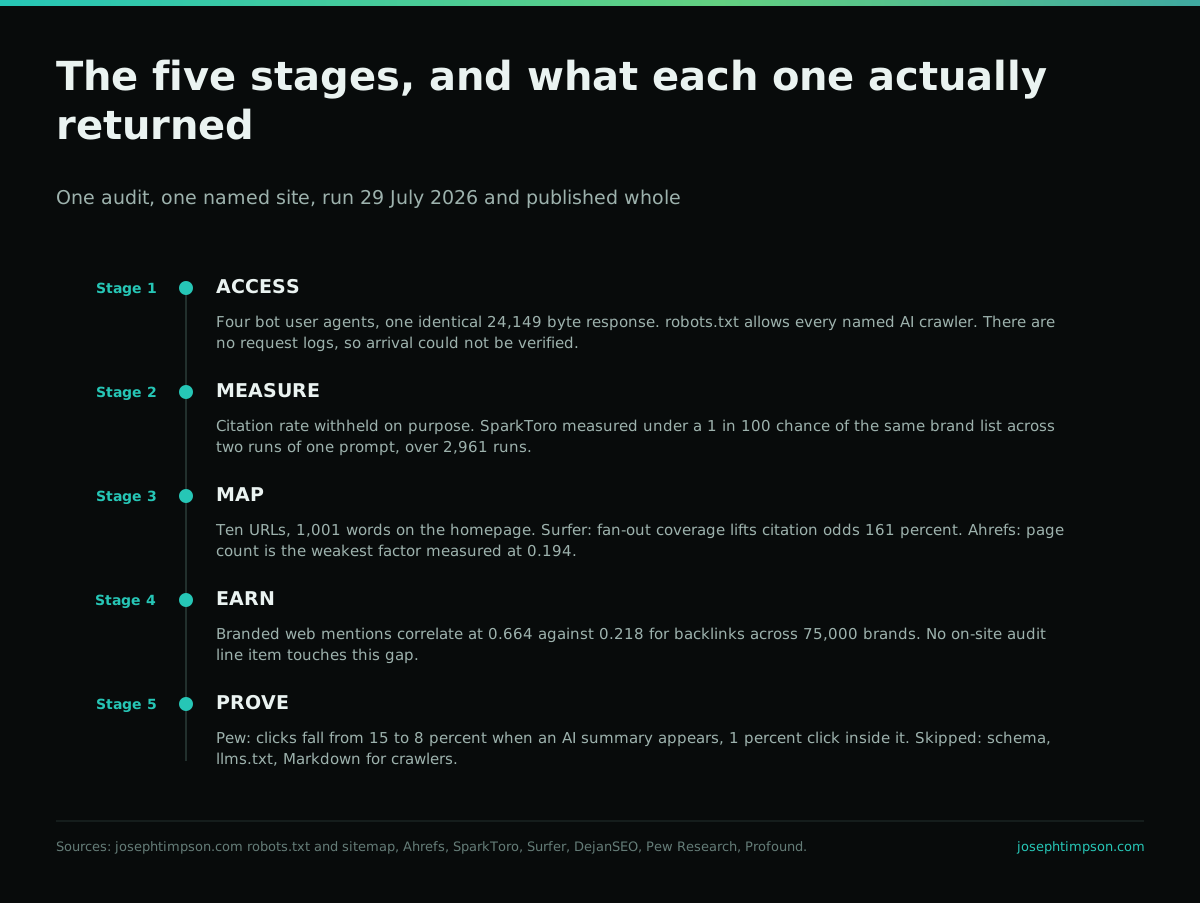
Stage one, ACCESS: four user agents, one byte count
This is the entire mechanical result. I requested the homepage four times, changing only the user agent string.
| Requesting agent | Status | Response bytes |
|---|---|---|
| OAI-SearchBot | 200 | 24,149 |
| ClaudeBot | 200 | 24,149 |
| PerplexityBot | 200 | 24,149 |
| Chrome desktop | 200 | 24,149 |
The status code is not the finding. The byte count is. A bot-managed edge will happily return HTTP 200 with a challenge shell, and a checklist that records "200 OK" scores that as a pass. Four identical byte counts is the only cheap proof that a retrieval crawler received the same document a person did.
Most audits grade this stage by reading robots.txt. Reading robots.txt tells you what you intended. Fetching as the bot tells you what happened. Those are different files, and I have watched them disagree on live client sites often enough that I now treat the read-only version of this check as decorative. The full method is in the crawler access audit.
My robots.txt passes, and it opens with a comment line that is the whole thesis of this site: "AI crawlers are welcome. Being reachable by them is the whole point." It names GPTBot, OAI-SearchBot, ChatGPT-User, ClaudeBot, PerplexityBot, Google-Extended and Applebot-Extended, each with an explicit Allow.
One detail there matters more than the rest. OpenAI's bots documentation states that sites opted out of OAI-SearchBot "will not be shown in ChatGPT search answers", and separately that ChatGPT-User "is not used to determine whether content may appear in Search." OAI-SearchBot is the ChatGPT visibility gate. GPTBot is the training crawler. Most robots.txt files I inherit block the wrong one of those two, and most audit reports do not distinguish them.
What stage one found against me
- There are no raw request logs. This site is served from Cloudflare and I do not have request-level logs for it. That means I verified crawler reachability and could not verify crawler arrival. Those are separate claims and I am not going to blur them. The half of the audit that reads bot hits is described in AI crawler log analysis and I could not run it here.
- /llms.txt returns 404, on purpose. See stage five.
That second one is not a failure, but every automated scanner in this category will report it as one.
Stage two, MEASURE: the number I refused to publish
The audit produced a citation rate. I am not publishing it, and the reason is the most useful thing in this post.
there's a <1 in 100 chance that ChatGPT or Google's AI, if asked 100X, will give you the same list of brands in any two responses
That came from 600 volunteers running 2,961 prompt executions across twelve prompts on ChatGPT, Claude and Google's AI. The same study measured an average semantic similarity of 0.081 across 142 human-written prompts asking for the same kind of recommendation. Read that second number slowly. Two consultants who both say they are tracking "best SEO consultant" queries are, statistically, tracking unrelated things.
A single sampling pass against a ten page site is a screenshot. Publishing it as a baseline would make this post worse than the templates I opened by criticising. What sample size actually survives that volatility is worked through in AI visibility sample size, and the prompt construction problem in building an AI visibility prompt set.
The one practitioner in this category I found publishing the limitation rather than the score puts it plainly:
However, they only tell you part of the story. For example, a 30% brand visibility score shows you're missing from most answers, but not which answers, which pages let you down, or which platforms ignore you.
There is a second reason the number is soft. Semrush and Growth Memo found that 61.7 percent of AI citations were ghost citations, where a page is used as a source link but the brand name never appears in the answer text, across 3,981 domain appearances in 14 countries and four engines. Citation counts and brand mentions are different metrics measuring different business outcomes, which is the distinction I work through in citations versus recommendations.
What I used instead of a vendor score
Both of the first party instruments are free, which is awkward for the tracking tool category. Microsoft's AI Performance report in Bing Webmaster Tools, launched in public preview in February 2026 by four Microsoft AI product managers, reports total citations, average cited pages, page level citation activity, visibility trends, and grounding queries. Grounding queries are Microsoft's own term for the subqueries Copilot generates internally, and they are the single most useful field any engine currently exposes.
Google announced Search Generative AI performance reports in Search Console in June 2026. I attempted that page twice and got the blog shell rather than the article body both times, so I am not going to describe fields I did not read. I can confirm the announcement exists. I cannot confirm its contents, and neither can most of the posts currently summarising it. How I compare the paid layer against those two is in AI visibility tracking tools.
Stage three, MAP: where the audit stopped flattering me
Stripped of scripts and styles, my homepage carries 1,001 words in the raw HTML, three JSON-LD blocks, one H1 and six H2s. It is server rendered, which matters because the only large scale log study on this, Vercel and MERJ's crawler analysis, found GPTBot fetched JavaScript files in 11.50 percent of requests and ClaudeBot in 23.84 percent, and neither executed them. That study is from December 2024 and nobody has replicated it at scale since, so I treat it as directionally true and dated rather than settled.
Then the sitemap: ten URLs, six of which are articles and four of which are the home, method, booking and index pages. Here is why that is a real problem rather than a cosmetic one. Surfer analysed 10,000 keywords and 173,902 URLs and found that pages ranking for both the head query and its fan-out subqueries were 161 percent more likely to be cited in an AI Overview than pages ranking for the head query alone, at a Spearman correlation of 0.77. A ten page site ranks for essentially no fan-out subqueries. The mechanics of that retrieval pattern are in query fan-out in AI Mode.
And here is the part where the obvious fix is wrong. Across 75,000 brands, Ahrefs found the number of pages on a site was the weakest factor it measured, at a Spearman correlation of roughly 0.194. So the prescription is not "publish two hundred pages." Page count and subtopic coverage are not the same variable, and the correlational studies measure the one that does not matter. That distinction is the difference between a content plan and a content treadmill, and almost every audit I have read conflates them.
There is a hard ceiling on the other side too. DejanSEO tokenised 2,275 pages across 7,060 queries and 883,262 snippets and found Google allocates roughly a 2,000 word grounding budget per query, with per source grounding plateauing near 540 words, and coverage falling from 61 percent for pages under 1,000 words to 13 percent for pages over 3,000. My 1,001 word homepage sits in the good band by accident. This post does not, and I know it. I am trading grounding coverage for citability as a reference document, which is a deliberate trade and one I would not make on a service page.
Stage four, EARN: the finding a website audit cannot fix
This is the stage where the product I sell looks weakest, so it is the stage worth reading.
Across the same 75,000 brand dataset, Ahrefs measured branded web mentions correlating with AI Overview visibility at 0.664 against 0.218 for backlinks, roughly three times weaker for links. The December follow up extended it to ChatGPT and AI Mode and put YouTube mentions at the top, around 0.737. Both papers state explicitly that correlation is not causation and that brand strength is a plausible common cause of everything on the list. Most secondhand coverage strips that sentence out. I am putting it back because it is the difference between a finding and a sales pitch, and I unpack it further in brand mentions and AI visibility.
The decoupling from classic rank is real and it is recent. Ahrefs' March 2026 pass over 863,000 SERPs and 4 million AI Overview URLs found only 38 percent of AI Overview citations come from pages ranking in the top 10, down from roughly 76 percent in Ahrefs' own July 2025 measurement. Any 2026 audit still opening with the 76 percent figure is quoting a number its own publisher has halved. That is the most common stale citation in this category and I check for it now the way I check for a missing canonical, which is the point of do AI Overviews cite top ranking pages.
Applied to my own site the finding is blunt. The largest gap is off-site presence, and there is no line item in a website audit that touches it. An audit that reports only what it can see inside your CMS will systematically under-report the thing that matters most, and the audit will still feel complete to the buyer. That is the structural dishonesty in this product, and it is not fixed by working harder on the on-site sections.
## Stage five, PROVE: attribution, stated honestly Pew Research ran a passive browsing panel of 900 US adults across 68,879 Google searches and found that users clicked a traditional result on 8 percent of visits where an AI summary appeared, against 15 percent without one, and clicked a link inside the summary itself on just 1 percent of visits. That is the most credible click loss number available because it is nonprofit panel data rather than vendor keyword modelling. Ahrefs separately estimates Google sends roughly 190 times more referral traffic than ChatGPT across 76,000 measured sites. Put those two together and the honest position on the whole category falls out: at current volumes AI search visibility is a consideration and preference play, not a traffic channel. Any audit that forecasts sessions from AI visibility is modelling, not measuring, and the model is doing all the work. The measurable and unmeasurable halves are separated in AI search attribution and turned into a client-facing format in GEO client reporting.
Book the audit→The three interventions I skipped, and the studies that justify skipping them
Every audit sample I read ends with a fix list. None of them publish a skip list. This is mine, and each entry has a controlled or large sample study behind it rather than an opinion.
JSON-LD schema. Ahrefs tracked 1,885 pages that added schema between August 2025 and March 2026 against 4,000 matched controls in a difference-in-differences design and found AI Overview citations fell 4.6 percent while AI Mode rose 2.4 and ChatGPT 2.2, the latter two statistically indistinguishable from zero.
Adding schema produced no major uplift in citations on any platform.
Google's own documentation agrees independently, stating that structured data isn't required for generative AI search and there is no special schema.org markup you need to add. The caveat Ahrefs states about its own study is that every page studied already had 100 or more AI Overview citations before treatment, so the data cannot speak to pages with zero visibility. I still ship schema on client sites, for classic rich results and entity disambiguation, and I no longer sell it as an AI citation lever. The full argument is in does schema help AI citations.
llms.txt. Ahrefs checked 137,210 domains, found 38,360 with an llms.txt file, and measured that 97 percent of those files received zero requests in May 2026, with AI retrieval bots making up 1.1 percent of the requests that did arrive.
If your goal is showing up in ChatGPT, Perplexity, or AI Overviews, an llms.txt file is largely decoration.
SE Ranking reached the same place from a different direction across nearly 300,000 domains, where 10.13 percent adoption showed no measurable relationship to citation and removing the feature actually improved their prediction model. Google states you do not need AI text files at all. Note that step eight of that LLM Pulse guide I linked at the top still tells you to audit your llms.txt. That is the category charging for a checkbox the primary source has already retired, which is why I wrote does llms.txt work as a standalone teardown.
Serving Markdown to crawlers. Profound ran 381 pages across six websites, 189 control and 192 treatment, over 21 days, and found no statistically significant increase in AI bot traffic from serving Markdown instead of HTML.
We tested the claim that serving Markdown to AI crawlers drives more bot traffic. The data doesn't support it, at least not at a scale that would justify treating it as a priority.
Rank the three by how confidently you should skip them, because they are not equal. llms.txt has two independent large sample studies plus a vendor statement against it and is the safest skip. Markdown has one genuinely controlled experiment and is a safe skip pending replication. Schema has one controlled study with a stated blind spot on zero-visibility pages, so skip it as an AI lever while continuing to ship it for classic search. That ranking is the kind of thing a fix list flattens and a skip list preserves.
What this should cost, and what you are actually buying
Published pricing in this category, per LovedByAI's breakdown, runs from 500 to 1,000 dollars for an automated scan, 1,000 to 2,500 for a hybrid review, and 2,500 to 5,000 plus for a deep dive including server log analysis. The article's own framing is that cost scales with the amount of manual human analysis required, which is correct and also an indictment of the bottom tier.
Hold that against what you just read. Stage one is ten minutes of work and I published the entire method and result for free. Stage five is a reading list. The only parts that genuinely take expert time are the prompt set, the repeated sampling required to beat the volatility Fishkin measured, and the interpretation of which findings you can act on versus which ones are off-site and slow.
- A byte-level crawler access test showing the response each named bot user agent received, not a robots.txt reading
- The full prompt set, published, so someone else can re-run it and get a different answer than you did
- The number of runs per prompt and the date range, because a single pass is a screenshot
- Separated citation and brand mention counts, because 61.7 percent of citations never name the brand
- A skip list with the studies attached, not only a fix list
- A named limitation section covering what the audit could not see
If a proposal on your desk cannot produce those six things, you are buying a report, not an audit. The method behind all five stages is written up in full at the Cited Method, the rest of this research sits in the insights index, and if you want it run against your domain rather than mine, book the audit.
One last honest note. This post runs past 3,000 words. By DejanSEO's grounding data that length works against per-page retrieval coverage, and I made the trade anyway because a reference document that gets linked and quoted earns the off-site mentions that stage four says matter more than anything on the page. That is a bet, not a finding, and I will publish the result either way.
Frequently asked questions
What is actually included in an AI visibility audit?
Five things: a crawler access test run with real bot user agents, a published prompt set with a stated run count, a citation and brand mention split, a fix list, and a skip list with studies attached. Anything beyond that is usually restated analytics you already own.
Why will nobody publish a real AI visibility audit example?
Because publishing one means publishing the client's weaknesses, and no client signs off on that. Every sample available is redacted or synthetic. The most widely used agency template states on the asset itself that every figure is a worked example rather than real data.
How do I test whether AI crawlers can actually reach my site?
Request your homepage four times, changing only the user agent to OAI-SearchBot, ClaudeBot, PerplexityBot and a normal browser string. Compare response byte counts, not status codes. A bot wall can return HTTP 200 with a challenge page and pass a naive check.
Should an audit report my AI citation rate as a single percentage?
No. SparkToro measured under a 1 in 100 chance that two runs of the same prompt return the same brand list, across 2,961 runs. A single-pass percentage is a screenshot. Any citation rate needs repeated sampling and a published prompt set to mean anything.
Does an AI visibility audit need to check llms.txt?
No, and audits that charge for it are selling a retired checkbox. Ahrefs found 97 percent of llms.txt files received zero requests in May 2026 across 137,210 domains, SE Ranking found no citation relationship across 300,000, and Google states AI text files are not needed.
Is schema markup worth including in an AI visibility audit?
As a classic search item, yes. As an AI citation lever, no. Ahrefs ran 1,885 treatment pages against 4,000 controls and found citations fell 4.6 percent in AI Overviews. Google's documentation independently states structured data is not required for generative AI features.
What does an AI visibility audit cost in 2026?
Published ranges run from roughly 500 dollars for an automated scan up to 5,000 or more for a deep dive with log analysis. Price tracks manual analysis hours. The mechanical checks take about ten minutes, so cheap automated tiers are selling you something you can run yourself.
Can an audit prove AI search drove a specific conversion?
No. There is no deterministic attribution path between an AI answer and a sale on any engine. Pew found only 1 percent of visits click a link inside an AI summary. Any audit that forecasts sessions from AI visibility is modelling, and the model does all the work.
Sources
- Google Search Central. Optimizing your website for generative AI features on Google Search (2026-07)
- Google Search Central Blog. Introducing Search Generative AI performance reports in Search Console (2026-06)
- OpenAI. OpenAI bots documentation (2026-07)
- SparkToro with Gumshoe.ai. New research: AIs are highly inconsistent when recommending brands or products (2026-01)
- Ahrefs. We analyzed 137K sites: 97% of llms.txt files never get read (2026-06)
- Ahrefs. Does schema markup increase AI citations? (2026-05)
- Ahrefs. An analysis of AI Overview brand visibility factors (75K brands studied) (2025-05)
- Ahrefs. AI brand visibility correlations across ChatGPT, AI Mode and AI Overviews (2025-12)
- Ahrefs. Only 38% of AI Overview citations come from the top 10 (2026-03)
- Ahrefs. ChatGPT has 12% of Google's search volume (2026-02)
- SE Ranking. LLMs.txt: adoption and impact across 300,000 domains (2025-11)
- Semrush with Growth Memo. The ghost citations study (2026-06)
- Surfer. Query fan-out impact on AI Overview citations (2025-12)
- DejanSEO. How big are Google's grounding chunks? (2025-12)
- Pew Research Center. Google users are less likely to click on links when an AI summary appears (2025-07)
- Profound. Does Markdown increase AI bot traffic? A controlled experiment (2026-02)
- Vercel with MERJ. The rise of the AI crawler (2024-12)
- Microsoft Bing Webmaster Blog. Introducing AI Performance in Bing Webmaster Tools (public preview) (2026-02)
- Position Digital. How to perform a GEO audit (2026)
- SEO Report Kit. AI visibility report template for agencies and consultants (2026)
- My Web Audit. AI visibility audit example: full walkthrough for agencies (2026)
- LLM Pulse. How to audit your brand's AI visibility (10-step guide) (2026)
- LovedByAI. How much does an AI visibility audit cost in 2026? (2026)
Joseph Timpson has worked in search since 2010 and runs Timpson Marketing out of St. George, Utah. He built The Cited Method, a five stage framework for earning and proving real citations in AI answers, and publishes what does not work alongside what does.
Want me to run this on your site and show you the before and after?
One call, no pitch deck. We look at what is actually blocking you and tell you the truth about whether we can help.
Book a free consultation →